Defining Probability
Probability Space
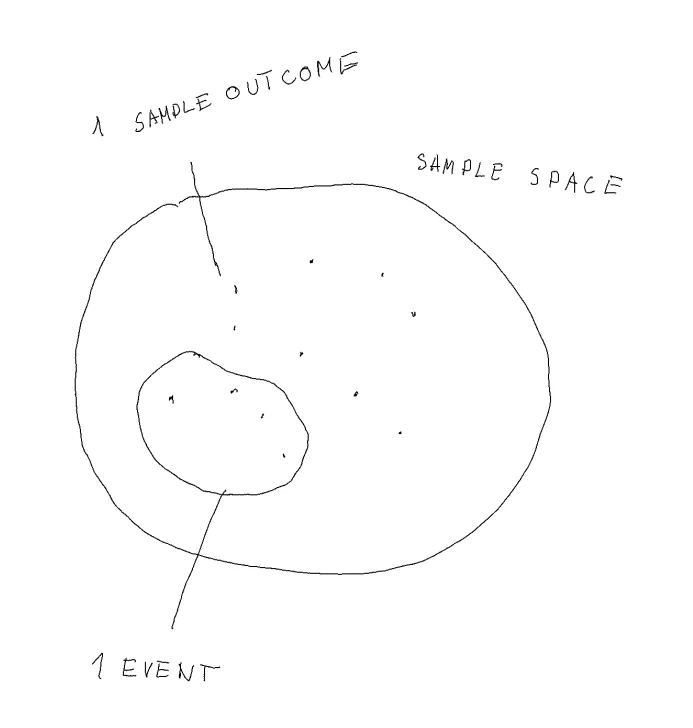
First we will define Probability Space, it consists of
- Sample Space $\Omega$
- Points in Sample Space are called Sample Outcomes
- Subsets of Sample Space are called Events
Example
We have an experiment with 1 draw from pack of cards:
- Sample Space - All possible draws
- Sample Outcome - (Elementaarsündmus)
- 1 card draw
- Example Events - (1 Event can contain multiple Sample Outcomes)
- Draw any card from Spades
- Draw any card more powerful than 6
Lets define probability
P,$\Omega$,F
- First we need to define F, the Events Space
- Event Space contains all possible events from Sample Space .
- This is it contains all possible subsets of Sample Outcomes from Sample Space.
- There is total $\Omega$ - $2^n$ subsets like that:
- n is the amount of sample outcomes
- Probability assigns now any event in F a certain probability P
Explaining $\Omega$ - $2^n$ with Example
Consider a simple experiment: rolling a fair six-sided die.
- Sample Space: $\Omega = \{1, 2, 3, 4, 5, 6\}$
- Sample Outcomes: Each face value, e.g., rolling a 3
- Event Space $F$: All $2^6 = 64$ possible subsets of $\Omega$
- Some example events:
- $A = \{2, 4, 6\}$ — rolling an even number
- $B = \{4, 5, 6\}$ — rolling a number greater than 3
To bring this into even simple terms: each column here stands for whether a sample outcome happened or did not happen (1/0). This means all subsets will be multiplications on 2/binary options.
| Event | 1 | 2 | 3 | 4 | 5 | 6 |
|---|---|---|---|---|---|---|
| $\{1\}$ | ✓ | |||||
| $\{2, 4\}$ | ✓ | ✓ | ||||
| $\{1, 3, 5\}$ | ✓ | ✓ | ✓ | |||
| $\{4, 5, 6\}$ | ✓ | ✓ | ✓ | |||
| $\{2, 3, 4, 5\}$ | ✓ | ✓ | ✓ | ✓ | ||
| ... |
Assigning probabilities (fair die → each sample outcome equally likely):
| Event | Outcomes | Probability |
|---|---|---|
| Roll an even number $A$ | $\{2, 4, 6\}$ | $P(A) = \frac{3}{6} = 0.5$ |
| Roll greater than 3 $B$ | $\{4, 5, 6\}$ | $P(B) = \frac{3}{6} = 0.5$ |
| $A \cap B$ (even and greater than 3) | $\{4, 6\}$ | $P(A \cap B) = \frac{2}{6} \approx 0.33$ |
Are A and B independent?
Check: $P(A)P(B) = 0.5 \times 0.5 = 0.25$, but $P(A \cap B) \approx 0.33$
Since $P(A \cap B) \neq P(A)P(B)$, events $A$ and $B$ are not independent, because knowing that the die rolled greater than 3 changes the probability of it being even (from $\frac{1}{2}$ to $\frac{2}{3}$)