Projection and Change of Basis
PROJECTION TOPIC Projection | Coursera
We have 2 vectors, s and r. We are looking for s projection (Shade) to r. Aka how much s moves in direction to r.
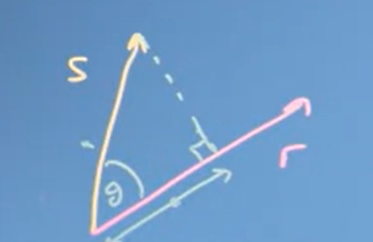
- If we look at the picture, then s is hypotenuse and its projection to r is $\theta$ adjacent(KÜLGNEV) side.
- $cos (\theta) = \frac{adj}{hyp} = \frac{\text{|projection vector|}}{|s|} => |s| cos(\theta) = \text{|projection vector|}$
- From the angle derivation based on cosine rule we get $s \cdot r = |r||s|cos(\theta)$
- From previous we know $|s|cos(\theta)=|\text{projection vector}|$
- Thus $s \cdot r = |r||\text{projection vector}|$
- Thus $\frac{s\cdot r}{|r|} = \text{|projection vector|} = \text{Projection length of s onto r}$ (Scalar Projection) The lengths units are in standard basis here. Intuitiivselt ma leian skalaarkoruutisega kui palju vektor s läheb samal suunal, mis vektor r ning jagamisega tagan, et see “KUI PALJU” oleks standardbaasi mõõtühikutes.
- if we are projecting on standard basis , then $|r|=1$ and projection to it becomes just regular dot product $s \cdot r$
- $\frac{r}{|r|}= \text{Vector going within the same direction as r but with length 1}$ (Unit vector in direction of r
- Proof :$\sqrt{\sum{\frac{r_i}{|r|}}^2}=\sqrt{\frac{1}{|r|^2}\sum{r_i}^2}=\sqrt{\frac{1}{\sqrt{\sum{r_i^2}}^2}\sum{r_i}^2}=\sqrt{\frac{1}{\sum{r_i^2}}\sum{r_i}^2}=\sqrt{1}=1$
- Scalar Projection * Unit Vector in direction R = Vector projection = $\frac{s\cdot r}{|r|} \cdot \frac{r}{|r|}$
- Projecting to different basis $\frac{s\cdot r}{|r|{|r|}}$ - explanation below. Opposing to regular projection, the length units are of r basis length here.
CHANGE OF BASIS
In the example above we are going to change the basis of the vector $r_e$ to use the basis $\hat{b_1},\hat{b_2}$
For this we first need to have the new basis $\hat{b_1},\hat{b_2}$ defined with $\hat{e}$ coordinates.
In this case
$b_1e= \begin{bmatrix} 2 \\ 1 \\ \end{bmatrix}=2*\hat{e_1}+1*\hat{e_2}$
$b_2e= \begin{bmatrix} -2 \\ 4 \\ \end{bmatrix}=-2*\hat{e_1}+4*\hat{e_2}$
Now we need to derive how r is looking like when described by basis b1 and b2
That means
- We need to describe r based on how much it goes towards $b_{1}$ and $b_2$ with length units of $b_{1}$ and $b_{2}$ accordingly.
To describe r by basis b for both b1 and b2 I need to
- Get scalar projection of r to $b_i$. $=> \frac{r \cdot b_i}{|b_i|}$
- Divide that scalar projection by $|b_i|$. We need to do this to describe direction to $b_i$ with length units of basis $b_i$ instead of basis $e_i$
NB, et antud projektsiooni funktsionaalsus toimuks baasivahetuse puhul peavad uued baasivektorid olema omavahel risti.