Z-Depth vs Euclidean Depth in Perspective Projection
This is Part 7 of the series:
- Understanding Camera Coordinate Transformations
- Orthographic Projection? 📸
- Viewport Transform for Orthographic LiDAR Projection
- Perspective Projection, Intrinsics, and Depth
- Orthographic vs Perspective: Scaling, the Perspective Divide, and Getting to Pixels
- Measuring Objects Viewed at an Angle in Perspective Images
- Z-Depth vs Euclidean Depth in Perspective Projection
- Creating a Point Cloud from Pixels and Depth
Table of Contents
- 1. The Difference
- 2. Reconstructing a 3D Point
- 3. Worked Example
- 4. Converting Between the Two
- 5. The Common Mistake
- 6. The Short Version
1. The Difference
A depth value does not always mean the same thing.
For a camera-space point
$ P=(X,Y,Z), $
two common definitions are:
| Depth type | Meaning | Formula |
|---|---|---|
| Z-depth | Forward distance measured parallel to the camera's optical axis | $Z$ |
| Euclidean depth or range | Straight-line distance from the camera center to the point | $r=\sqrt{X^2+Y^2+Z^2}$ |
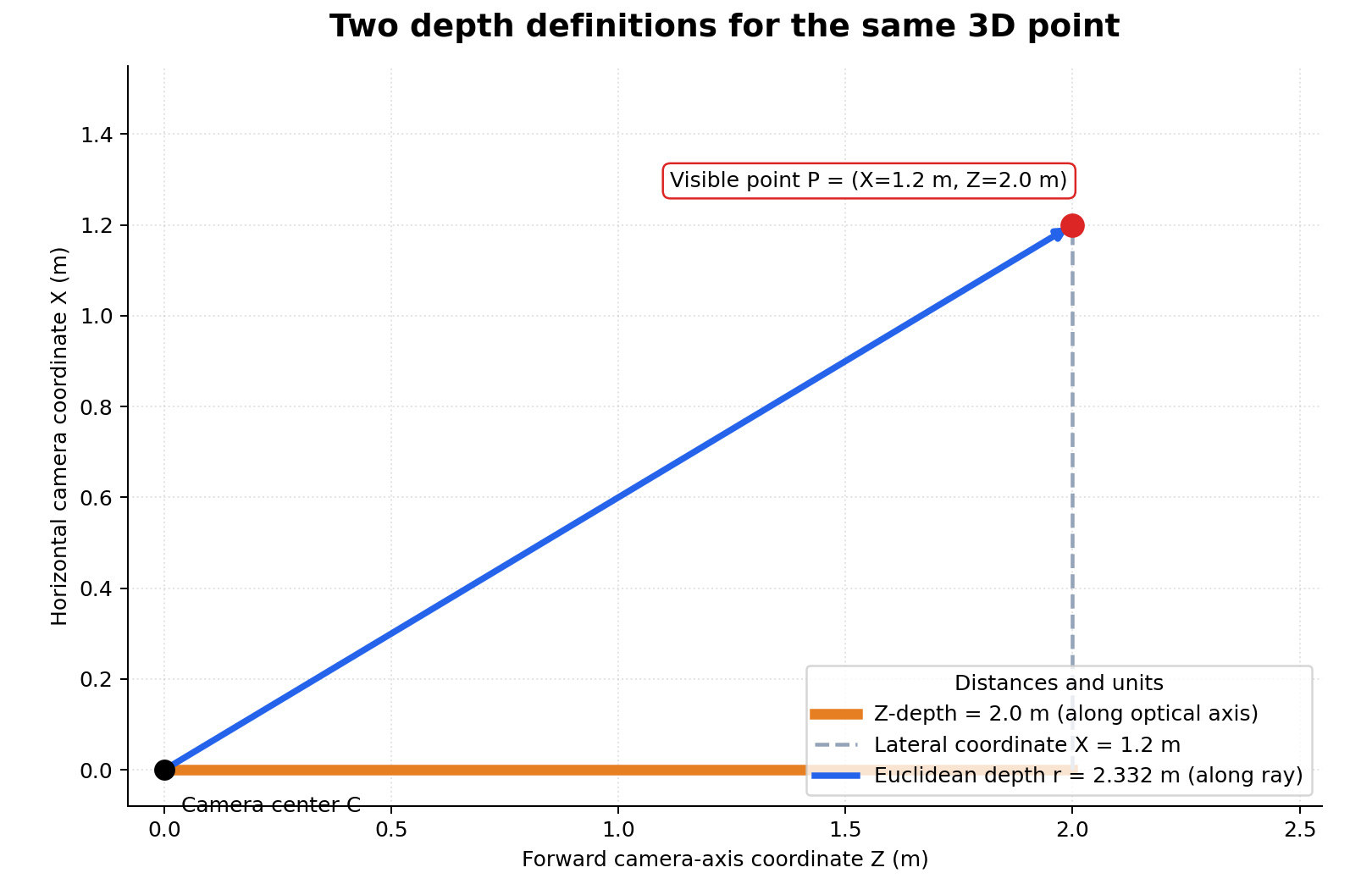
The orange line is Z-depth along the optical axis, while the blue line is Euclidean depth along the viewing ray. All distances are in meters.
The two values are equal only for a point on the optical axis. Away from the image center, Euclidean depth is larger because the viewing ray is diagonal.
2. Reconstructing a 3D Point
For pixel $(u,v)$ and camera intrinsics $(f_x,f_y,c_x,c_y)$, first form the unnormalized camera ray:
$ q= \begin{pmatrix} \dfrac{u-c_x}{f_x}\\[4pt] \dfrac{v-c_y}{f_y}\\[4pt] 1 \end{pmatrix}. $
Its last component is 1, so it is convenient when the depth map stores
Z-depth:
$ P=Zq. $
If the depth map instead stores Euclidean depth $r$, normalize the ray:
$ d=\frac{q}{\lVert q\rVert}, \qquad P=rd. $
The important distinction is:
Z-depth:       multiply the unnormalized ray q
Euclidean depth: multiply the unit ray d
3. Worked Example
Suppose:
fx = fy = 500 pixels
cx = 320 pixels
cy = 240 pixels
pixel = (620, 240)
The pixel is 300 pixels to the right of the principal point:
$ q= \begin{pmatrix} (620-320)/500\\ (240-240)/500\\ 1 \end{pmatrix} = \begin{pmatrix} 0.6\\ 0\\ 1 \end{pmatrix}. $
The length of this ray vector is:
$ \lVert q\rVert=\sqrt{0.6^2+0^2+1^2}\approx1.166. $
If the sensor reports Z-depth = 2 m
$ P=2q=(1.2,\ 0,\ 2.0)\text{ m}. $
The point is 2 m forward, but its Euclidean distance from the camera is:
$ r=\sqrt{1.2^2+2.0^2}\approx2.332\text{ m}. $
If the sensor reports Euclidean depth = 2 m
First normalize the ray:
$ d=\frac{(0.6,0,1)}{1.166}\approx(0.514,\ 0,\ 0.857). $
Then:
$ P=2d\approx(1.029,\ 0,\ 1.715)\text{ m}. $
Now the point is exactly 2 m from the camera, but only about 1.715 m forward.
| Input value | Resulting point $(X,Y,Z)$ in meters | Other depth |
|---|---|---|
| Z-depth = 2 m | $(1.200,0,2.000)$ | Euclidean depth = 2.332 m |
| Euclidean depth = 2 m | $(1.029,0,1.715)$ | Z-depth = 1.715 m |
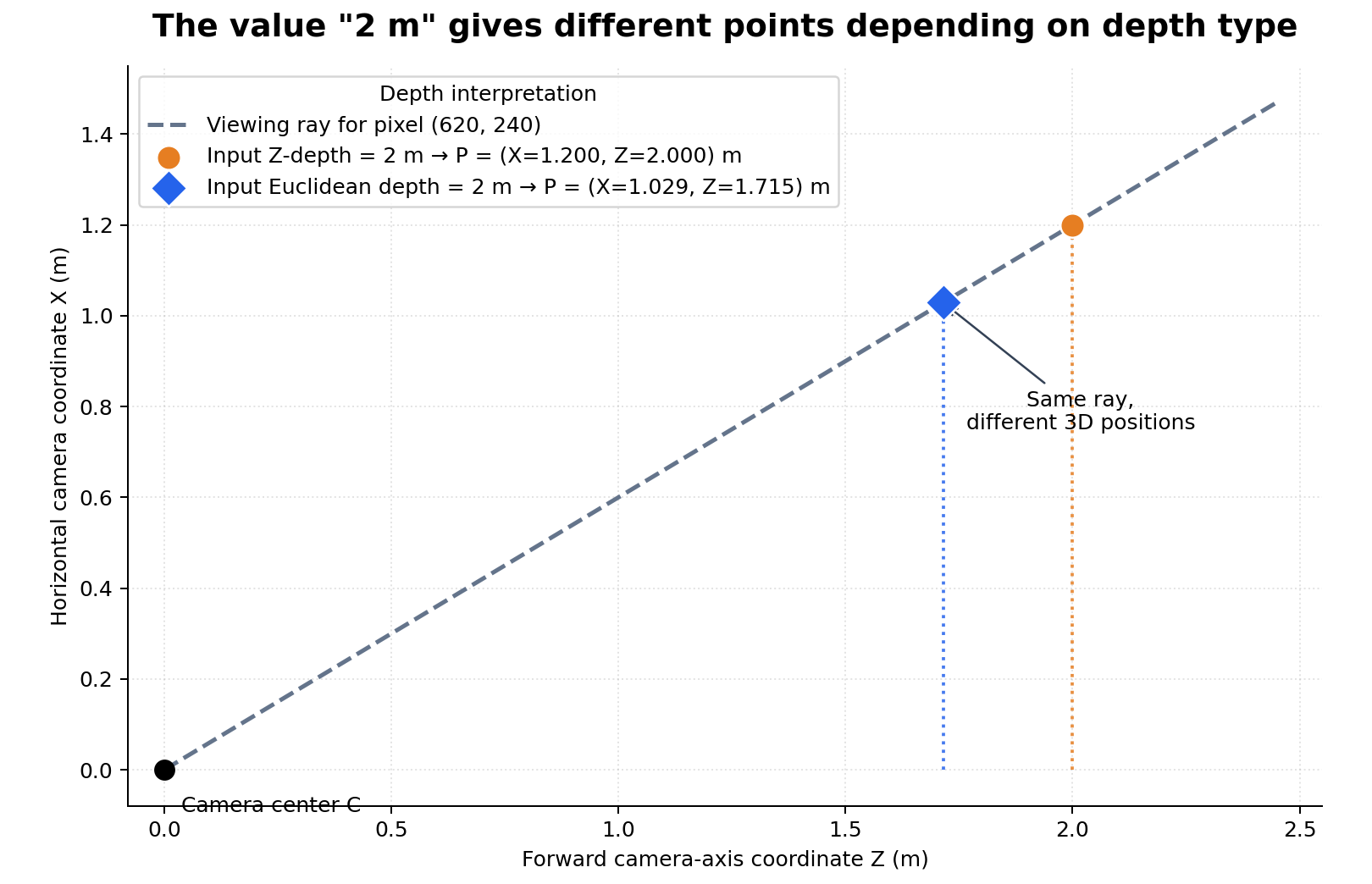
Both points lie on the same viewing ray, but interpreting 2 m as Z-depth
places the point farther from the camera than interpreting it as Euclidean
depth.
This is why using the correct depth definition matters most near the edges of an image. At the principal point, $q=(0,0,1)$, so both definitions give the same result.
4. Converting Between the Two
Because
$ P=Zq=rd, $
the conversion is:
$ r=Z\lVert q\rVert $
and:
$ Z=\frac{r}{\lVert q\rVert}. $
Written directly using the pixel and intrinsics:
$ r= Z\sqrt{ \left(\frac{u-c_x}{f_x}\right)^2+ \left(\frac{v-c_y}{f_y}\right)^2+ 1 }. $
5. The Common Mistake
If a sensor gives Euclidean depth $r$, this is wrong:
point = r * ray
when ray is the unnormalized vector $q$. The resulting point will be farther
than $r$ from the camera.
Use:
ray = np.array([
    (u - cx) / fx,
    (v - cy) / fy,
    1.0,
])

if depth_type == "z":
    point = depth * ray
elif depth_type == "euclidean":
    point = depth * ray / np.linalg.norm(ray)
else:
    raise ValueError(f"Unknown depth type: {depth_type}")
Always check the sensor or library documentation for terms such as
z-depth, axial depth, range, radial depth, or distance.
6. The Short Version
- Z-depth measures how far forward the point is.
- Euclidean depth measures the straight-line distance to the point.
- Use $P=Zq$ for Z-depth.
- Use $P=r(q/\lVert q\rVert)$ for Euclidean depth.
- They are equal at the principal point and increasingly different toward the image edges.
In one sentence:
Z-depth follows the camera's forward axis; Euclidean depth follows the pixel's viewing ray.